
Dinosaurs ruled this planet for over 150 million years before they went extinct nearly 70 million years ago.All that was left behind were bones, teeth, footprints, and a few crystallised secrets buried deep in the ground. For centuries, fossils have been our only window into their world. They show us how big these giants were, how they walked, and even what they might have eaten.But there was no trace of blood, a major component that helps the body function, to be found.Only until now.Recently, scientists looked inside a 115-million-year-old dinosaur bone from Brazil and found tiny structures that look like red blood cells, along with chemical traces of heme, a molecule that helps blood carry oxygen. It is the first time such traces have been chemically proven inside cells like these in a dinosaur fossil.Let us know what this discovery opens the window for.
Dinosaur Blood Cells? What a 115-Million-Year-Old Bone Is Telling Us
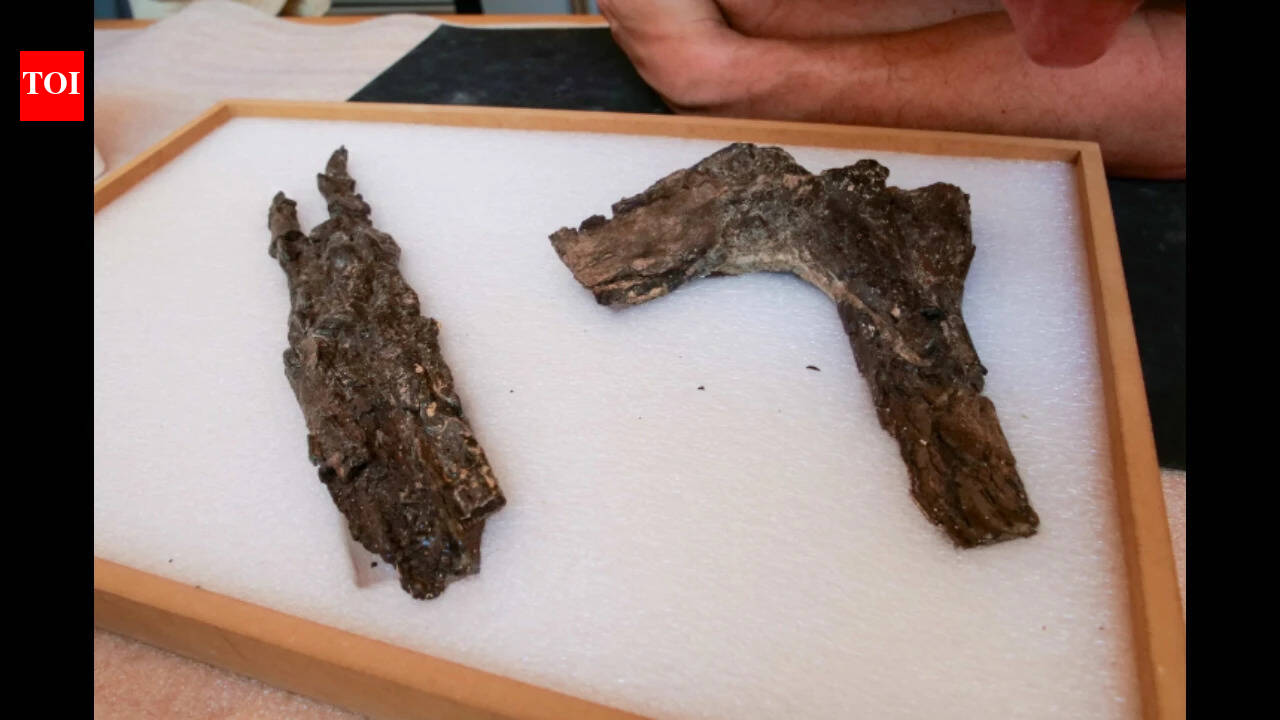
According to a Curtin University news release, an international team led by the university found mineralised red blood cells and heme molecules in the limb bones of a 115-million-year-old theropod dinosaur, Aratasaurus museunacionali. The study appeared in Proceedings of the National Academy of Sciences. Lead author Professor Kliti Grice said, “this really is a landmark discovery.”According to a Discover Wildlife report, such discoveries of biomolecules in fossils is rare and becomes less likely as fossils get older, because these delicate molecules are easily altered or destroyed during fossilisation. Earlier studies had reported shapes that looked like red blood cells, but this is the first to chemically prove haemoglobin-derived molecules, called heme B, inside such cells.
What is Heme and why is it so important?
Heme is an iron-containing molecule that helps haemoglobin carry oxygen around the body. Inside the dinosaur’s bone, the researchers noticed tiny oval shapes in the narrow channels that once held blood vessels.When they tested those same spots, they found chemical traces of heme, a molecule linked to blood. To read the bone’s chemical fingerprint, the team used a special technique called high-performance liquid chromatography-mass spectrometry.But they wanted to be sure the heme had not come from somewhere else. So they tested the rock around the bone as well. It had no heme B, only traces of chlorophyll and bacteriochlorophyll, which are not found in blood. This suggests the heme really did come from the dinosaur’s bone.
But how did the blood in dinosaur bones stay intact for so long?
The researchers believe these bones stayed in such good condition because the dinosaur was buried very quickly after it died, in a place with little oxygen and lots of microbes. They also think a chemical compound called hausmannite turned the red blood cells into minerals. This helped hold the cell shapes and the molecules inside them in place, turning them into natural time capsules.Professor Kliti Grice said to Discover Wildlife, “These findings challenge longstanding assumptions that certain biomolecules such as haemoglobin cannot survive deep time. It opens exciting new avenues for molecular-level palaeontology, allowing us to investigate the evolution of blood, metabolism, and even activity levels in ancient animals.”
So, does the blood contain DNA?
Fossilised cells hold no traces of DNA, and DNA is thought to last far less time than the dinosaurs have been extinct.What the finding does offer is a new way of studying the past. Grice said, “It opens exciting new avenues for molecular-level palaeontology,” according to Discover Wildlife, which could help scientists explore how dinosaur blood, metabolism, and even activity levels worked.Sometimes the biggest stories come from the smallest clues, and this one is hiding inside a bone.The oldest evidence of DNA has been found by scientists from a mammoth’s back teeth found in Siberia, and at around 1.1 million years old, it is among the oldest ever found. Dinosaurs, however, died out 66 million years ago, far longer than researchers believe genetic material can last. So finding dinosaur DNA is still only a dream from science fiction.But this discovery points to another exciting path. Ancient molecules like heme B could help scientists learn how long-extinct animals lived, how their bodies worked, and maybe even what their daily lives were like.
Source link
Auto GoogleTranslater News