

A couple may be happy together, enjoy their evenings on the sofa and look forward to sharing meals after work. But if those routines regularly involve little physical activity, poor sleep and an unhealthy diet, their relationship may not offer the health benefits they expect. A study by researchers at the University of Alabama at Birmingham (UAB) has found that a happy marriage may be linked to healthier biological ageing when partners also maintain healthy habits. When couples share unhealthy routines, however, relationship happiness may not provide the same benefit and could be associated with less favourable ageing markers.The findings suggest that how couples live together may matter as much as how satisfied they feel with their relationship. The study was led by Stephanie J. Wilson, a development-health psychologist at UAB.
What did the researchers find?
The researchers studied 107 married or cohabiting couples aged 40 to 87. They assessed relationship quality, sleep, diet and physical activity, and collected blood samples to measure biological ageing. The measures included DNA methylation-based ageing clocks, p16INK4a (a marker associated with cellular ageing), and telomere length.The findings were mixed. Happier relationships were associated with lower p16INK4a expression, suggesting less cellular ageing. But the association between relationship quality and biological ageing also depended on couples’ health habits. Better sleep, healthier diets and physical activity were linked to more favourable patterns, while some associations between relationship satisfaction and ageing markers were less favourable.The study also found that better relationship quality predicted smaller increases in p16INK4a over time, but was associated with shorter telomeres. The results suggest that relationship quality alone may not determine how couples age biologically; their shared health habits may also matter. The researchers cautioned that these findings are preliminary. The study shows associations, not proof that a happy marriage or particular habits directly cause changes in biological ageing.
How can couples influence each other’s health?
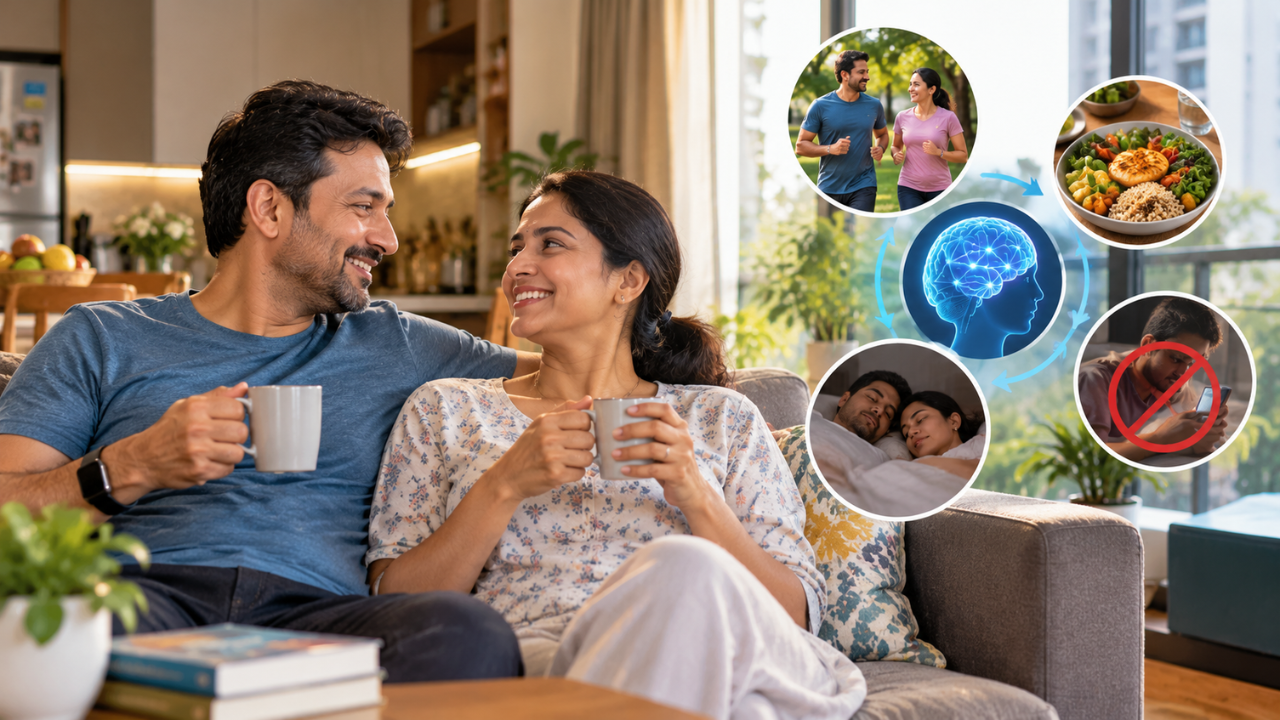
AI representation/ChatGPT
Partners often shape each other’s daily routines without consciously deciding to do so. One person may encourage the other to go for a walk, prepare a balanced meal or maintain a regular bedtime. Over time, these choices can become shared habits. But the same influence can work in the opposite direction. A couple that regularly orders calorie-dense meals, stays up late watching television or spends most evenings sitting together may gradually make those behaviours part of its normal routine.Stephanie Wilson explained in the UAB report that routines associated with bonding can reinforce unhealthy behaviours, too. Watching a show together while eating ice cream or drinking alcohol may feel relaxing, for example, but it can become a repeated pattern.This does not mean that couples should stop enjoying meals, films or quiet evenings together. Rather, the findings highlight how the habits partners share can become relevant to their long-term health.
What is biological ageing, and how is it different from your age?
Chronological age is the number of years a person has lived. Biological ageing refers to changes in the body’s cells and systems over time. Researchers use measures such as DNA methylation patterns and cellular markers to investigate whether a person’s biology shows signs associated with faster or slower ageing. These measures can offer information about health-related processes, but they are not a precise prediction of how long an individual will live.In this study, the researchers did not find that a happy marriage directly adds or subtracts years from a person’s life. They examined associations between relationship quality, health behaviours and biological markers.
What can couples change together?
The study points to three practical areas where partners can support each other: physical activity, sleep and diet.
- Make movement part of the routine: Couples can take regular walks, cycle together or choose activities they both enjoy.
- Protect sleep: Agreeing on a more consistent bedtime, reducing late-night screen use and avoiding routines that repeatedly cut into sleep can help both partners.
- Plan meals together: Shopping for nutritious foods and preparing meals at home more often can make healthier choices easier for both people. Occasional treats need not disappear; the focus is on the pattern over time.
The research has limitations. The sample was relatively small and consisted predominantly of healthy and highly educated couples. The researchers also excluded people with several serious chronic conditions, so the findings may not apply equally to all couples. Because the study was observational, it cannot establish that marital happiness or shared habits directly caused the changes in biological ageing markers. Larger and more diverse studies will be needed to understand the relationship more clearly.
Source link
Auto GoogleTranslater News