
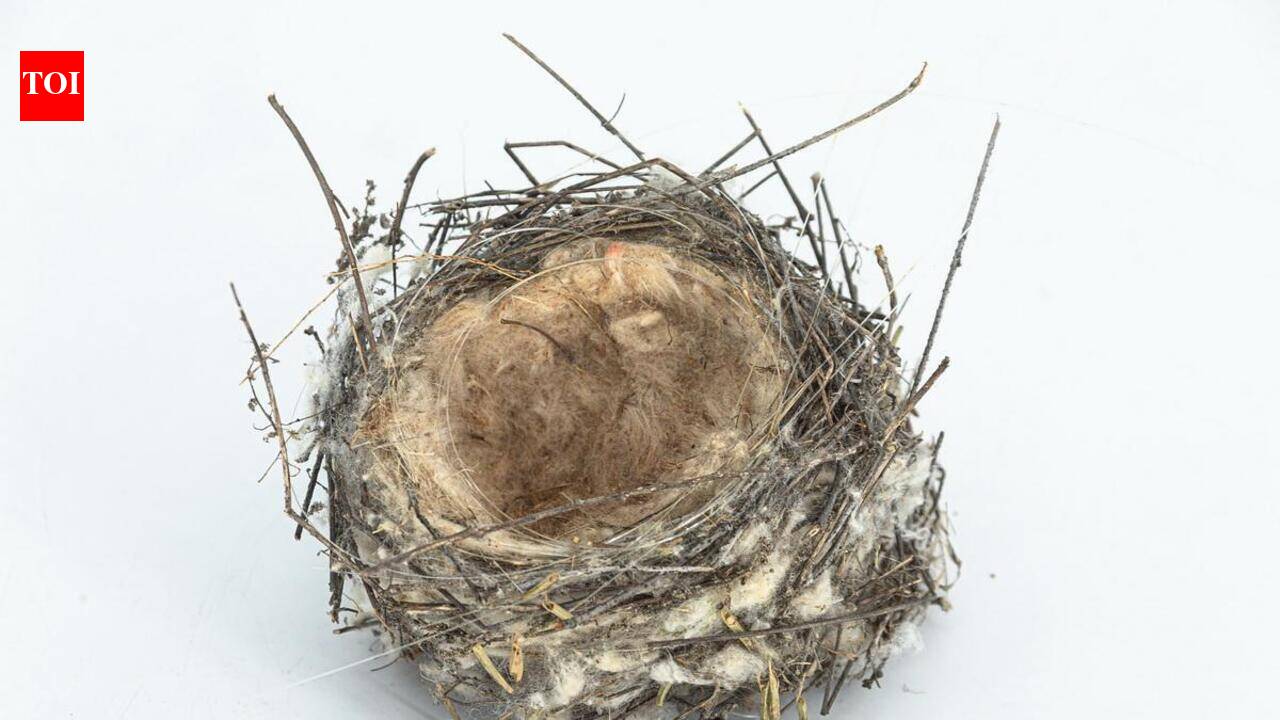
Pune: On Ukraine’s frontlines, birds are building nests with the detritus of a new kind of warfare — strands of fibre-optic cable that trail behind drones and allow them to fly beyond the reach of electronic jamming. The nests have become a larger effort by a war museum in Kyiv to keep contemporaneous records of the Ukraine-Russia war.One such nest, found near the village of Chorne in Kupiansk district in the Kharkiv region, is part of a larger collection at National Museum of the History of Ukraine in the Second World War. The nest was discovered during a combat mission by Mykhailo Mlechko, an operator-gunner with a border guard detachment, who decided to preserve it.For curator-researcher Yana Hrynko, who worked with the museum when the nest was brought in, its significance became immediately apparent, not through appearance but through odour — the “smell of war”.“It seemed to me that these nests have a different smell, distinct from that of purely natural ones … It is strange to see these nests up close. The cables and natural materials — twigs, stems, grass — are woven together very delicately,” Hrynko tells TOI.Since the discovery of the first nest last year, Hrynko has seen military personnel post about other such nests on social media, though in most cases, they did not retrieve these nests.Hrynko says this is a dilemma. “Collecting such nests is not part of their duties and as civilians, museum workers do not have access to all areas — the area covered by fiber-optic cables is a kill zone, and a museum worker cannot simply enter,” she says, reasoning that a key goal here is to not get in the soldiers’ way. “The documentation of such nests depends on individual initiative and the capabilities of military personnel, as well as contact with museums,” she says.The nest occupies a unique place in the war museum. “The museum does not specialise in ornithology; it deals with the histories of wars. But because the nest contains elements of military equipment and reflects the ongoing war’s impact on the environment, it was transferred specifically to the War Museum,” said Hrynko.The nest has been documented by French photojournalist Gaëlle Girbes for ‘Ecocide in Ukraine’, a documentary presented at the international photojournalism festival Visa pour l’Image in Sept 2025.The most important lesson from this nest, Hrynko says, is to expand the understanding of what makes for a war museum artefact, with musealisation of the Russia-Ukraine war happening very nearly in real time. Musealisation is the process of converting an object into a museum piece. “It is necessary to look at objects from the perspective of the future: what they tell future generations?”In such cases, an object is an artefact and material evidence of an ever-changing military conflict. “The war is not over: its nature, its boundaries are changing, and the front keeps shifting,” says Hrynko.These birds’ nests are not the only curated artefacts of this war at the museum — while working there, Hrynko also collected headstone crosses from a mass burial ground in Izium, a city in the Kharkiv region that was rapidly overrun by Russians in 2022. “Approximately 600 people were killed, leading to the creation of the mass grave,” she says.The site was discovered in Sept 2022, when Ukraine liberated the city. The bodies were exhumed and reburied properly. “These crosses — often marked with numbers and sometimes made from baseboards — entered the museum’s collection,” Hrynko says. Russia denies its responsibility for what happened in Izium, but Hrynko says the crosses are records of war crimes.The same logic, she said, applies to the fibre-optic nest, although its story is ecological and technological rather than directly human.Auke-Florian Hiemstra, a biologist who focuses on plastic pollution, is currently studying the nests. His ongoing research could establish more about the birds that built them and the effects of war on them.Decades from now, Hrynko said, such nests could be read as records of the fibre-optic-drone era. They may also show how military technology can leave traces far beyond the battlefield, becoming part of the landscape and the natural world.
Source link
Auto GoogleTranslater News